
Couples Therapy in English in Spain: When It Helps, and What International Couples Should Know
Couples therapy in English is available in Spain online, with licensed psychologists who see both of you by video, either together in one room or from two different places. It is not a last resort: a 2020 meta-analysis found that couples in therapy improved their relationship satisfaction substantially, while couples left on a waiting list showed no significant improvement on their own. For international couples there is one more reason to start: in a language you both speak well, neither of you has to argue at a disadvantage.
Below: how to tell a rough patch from a pattern, what is different when you love across languages and cultures, how online sessions work, and when couples therapy is not the right step.
A rough patch or time to get help?
Every couple goes through hard months. A new baby, a move, a job that swallows one of you, an illness in the family. Struggling during those months does not mean something is broken. What matters is whether you can still find your way back to each other.
| A rough patch | Time to get help |
|---|---|
| You argue, and afterwards you repair | The same argument comes back again and again and never ends |
| You are busy and see less of each other | You live like flatmates and no longer share what matters to you |
| Apologies land and things settle | Apologies feel empty, or sarcasm and contempt have crept in |
| You disagree about a big decision but can talk about it | A decision (where to live, children, caring for a parent) has stalled everything else |
| Trust was dented and you talked it through | An affair or a broken promise you cannot get past on your own |
| You feel frustrated with each other at times | You feel lonely inside the relationship most of the time |
If more of your life sits in the right-hand column, it is worth getting help sooner rather than later. A common worry is that it is "too late". The same 2020 meta-analysis, which pooled studies covering more than 2,000 couples, found that couples who started therapy more distressed tended to make larger gains, and that improvements were generally maintained at follow-up. The studies it included were of opposite-sex couples only, a gap the authors point out themselves.
What is different for international couples
Couples from two countries share everything other couples face, plus a few things they rarely get to talk about with anyone who understands.
The language of conflict
Many international couples live their relationship in a language that is the first language of only one of them, or of neither. Day to day, it works. In an argument, the imbalance shows. The partner using a second language reaches for words more slowly, misses nuance, and can come across as colder or blunter than they feel. The partner using their first language can sound more reasonable simply because they have more words.
Research backs up what many couples notice. In a study of 429 people in cross-cultural relationships, published in the Journal of Pragmatics in 2017, about half described limits in the foreign language when it came to emotions, and a lack of emotional resonance in it. The encouraging part: for most participants these difficulties faded over time, and in longer relationships the partner's language often became a language of the heart. A smaller group even found the foreign language freeing.
So language is rarely the whole problem. It is the place where other problems become harder to sort out.
Families, holidays and loyalty
Two families, often in two countries, usually with different ideas about how close a family should be, how often you visit and who hosts the holidays. One partner may feel the other's family is intrusive; the other may feel their family is being rejected. Behind most of these arguments is a question of loyalty: whose way of doing things counts as normal?
Belonging and where to live
In many international couples one partner is at home and the other is the guest. The guest may have left a career, a language and a whole network of friends. The one at home may not notice how much that costs, or may feel guilty about it in silence. Arguments about where to live, now or in ten years, are rarely about geography. They are about whose life gets to be the default.
Raising children between cultures
Which language at home, which school, which grandparents' customs. Couples who agreed easily before children often discover they hold strong views they never had to say out loud.
Why both partners need equal footing in the language
If one partner speaks fluent Spanish and the other does not, couples therapy in Spanish quietly tilts the room. The psychologist hears one partner's full voice and the other's reduced one, and the less fluent partner may end up agreeing with things just to keep up. Couples therapy only works if both of you can say exactly what you mean.
For many international couples, English is the language where that balance is closest. Working with a psychologist who also speaks Spanish has another advantage: when one of you reaches for a word in your first language, it does not get lost, and the psychologist can help bring it back into the shared conversation.
In couples sessions I always notice which partner is working harder just to be understood. When one argues in their first language and the other in a second, the fluent one often sounds more reasonable simply because they have more words. Part of my job is to slow the conversation down until both voices weigh the same.
How online couples sessions work
Online couples therapy is a video call with the psychologist. A few practical points make it work well:
- Together or apart. Most couples join from the same room, sitting side by side in front of one screen. If one of you travels for work or you are living in different cities for a while, each of you can join from your own device.
- One device, if you share a room. Two laptops in the same room create echo. Use one screen and, if you can, an external microphone.
- Privacy. Choose a room where children or flatmates cannot hear, and do not put a work call straight after the session. Give yourselves a few minutes to land.
- Between sessions. Your psychologist may suggest small things to try during the week. They work best when you agree beforehand what you will do if an old argument starts again.
Some psychologists also see each partner on their own once early on, to hear each side without the other present. Ask how yours works in the first conversation. If you are still deciding whether therapy with a psychologist in Spain is the right choice, we explain how to check a psychologist's registration in our guide to finding an English-speaking therapist in Spain.
When couples therapy is not the right step
Couples therapy assumes that both partners can speak freely and safely. That is not the case when there is violence, threats or coercive control. The World Health Organization counts controlling behaviours as a form of intimate partner violence alongside physical aggression, sexual coercion and psychological abuse. In everyday life, control can look like checking your phone, controlling your money, cutting you off from friends and family, or making you afraid of how your partner will react to what you say.
In that situation the problem is not communication, and joint sessions can make you less safe, because what you say in the room may be held against you at home. Individual support comes first.
In Spain, 016 is the national helpline for all forms of violence against women and for the people around them. It is free, open 24 hours a day and attended in English as well as Spanish, among many other languages. You can also write on WhatsApp to 600 000 016 (it does not take calls). If you or anyone else is in immediate danger, call 112, whoever you are.
Couples therapy can also wait when one partner is in an acute personal crisis or has an untreated addiction that dominates daily life. In those cases individual help usually comes first, and couples work can follow.
Frequently asked questions
Can we do couples therapy in English if one of us is Spanish?
Yes. Many international couples choose English because it is the language in which both partners are most at ease. With a psychologist who also speaks Spanish, either of you can use a word in Spanish when English falls short.
What if my partner does not want to come?
You can start on your own. Individual therapy can help you understand your part in the pattern and decide what you want, and sometimes a partner who refuses at first feels differently once the idea is less threatening. Invite rather than insist.
How long does couples therapy take?
There is no fixed number of sessions. Some couples come for a few sessions around a specific decision; others work for longer on patterns that have built up over years. Your psychologist can give you a realistic idea after the first sessions.
Does online couples therapy work if we live in different cities?
It can. Each of you joins the video call from your own device, so distance stops being an obstacle. A stable connection and a private room on both sides matter more than being in the same place.
If you would like to work on your relationship in English, two of our licensed psychologists see couples in English and Spanish. Carmen María García Ramos (registration AN11508, COP Andalucía Occidental) works with couples, trauma and attachment: book a first session with Carmen. Gara Arteaga González (registration P-03298, COP Las Palmas) has specific training in couples therapy and attachment, and experience in family intervention and mediation: book a first session with Gara. Sessions are online by video, from anywhere in Spain or abroad, and the first 30-minute assessment is free and carries no commitment. If one of you prefers to read in Spanish, we have also written about mixed couples and therapy in English (in Spanish).
Sources
- Meta-analysis of couple therapy: Effects across outcomes, designs, timeframes, and other moderators — Journal of Consulting and Clinical Psychology, 2020
- Loving a partner in a Foreign Language — Journal of Pragmatics, 2017
- Violence against women (fact sheet) — World Health Organization, 2026
- Teléfono 016 — Delegación del Gobierno contra la Violencia de Género — Ministerio de Igualdad
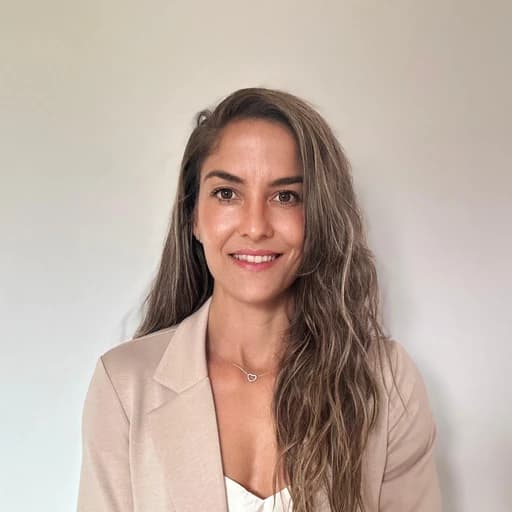
Written and reviewed by
Yanira Soto Cabrera
Licensed general health psychologist (Psicóloga General Sanitaria) · Registration No. T-03737 (COP Santa Cruz de Tenerife)
Co-founder of AtHomePsicología. Over 10 years of clinical experience with anxiety, depression, relationship difficulties and self-esteem, working from cognitive behavioural therapy (CBT).
Meet our English-speaking psychologists