
English-Speaking Therapist in Spain: How to Find a Licensed Psychologist, and Why Your Language Matters
The simplest way to find an English-speaking therapist in Spain is to look for a licensed psychologist who works online in English: in Spain that means a Psicólogo/a General Sanitario/a with a registration number from an official College of Psychology, and they can see you by video wherever you live. Before you book, ask for that registration number and look it up in the College's public register: it is free, and it tells you whether the person is currently authorised to practise. And if English is your first language, it is worth having therapy in it, because emotions tend to land harder in the language you grew up with.
Below: why language matters, how to check a psychologist in Spain, how the main options compare, and what a first session actually looks like.
Why therapy in your first language matters
Many people who live in Spain speak good, even excellent, Spanish. They work in it, argue with the landlord in it, make friends in it. So it is fair to ask whether therapy in English is a luxury.
The research suggests it is not. A review by the psychologist Catherine Caldwell-Harris, published in Current Directions in Psychological Science, brings together studies showing that emotional words and phrases tend to provoke a weaker physical response in a foreign language than in a native one. In skin-conductance studies, which measure a small, automatic stress reaction, emotional phrases in a second language moved the needle less than the same kind of phrases in a first language.
That distance cuts both ways:
- It can protect. Some people find it easier to approach a painful subject in their second language, precisely because it hurts less to say it.
- It can disconnect. If you can only talk about your life in a language that keeps feelings at arm's length, you may describe a hard experience accurately and still not feel it in the session. Therapy then becomes a report, not a change.
A survey of 182 multilingual clients, published by Jean-Marc Dewaele and Beverley Costa in Language and Psychoanalysis, found that clients switched languages most often when the emotional tone rose, and used that switch on purpose when talking about trauma and shame, to get closer to a memory or to put some distance between themselves and it. The authors concluded that switching let clients express themselves more fully, adding depth and nuance to the work.
The practical conclusion is not "always English" or "never Spanish". It is that you should be able to choose the language of your therapy, and to change it mid-sentence if you need to.
People who have lived for years in a second language often tell me they can describe the hardest moments of their lives in it perfectly well, and feel almost nothing while they do. When they switch to their first language, the feeling arrives. Neither language is wrong in therapy. But you should be able to choose the one that reaches you, not only the one that explains you.
How to find a licensed psychologist in Spain
Titles work differently in Spain from what you may be used to at home. Here is what to look for.
1. The title: Psicólogo/a General Sanitario/a
A psychologist who provides health care in Spain will usually present as Psicólogo/a General Sanitario/a (PGS), which translates as licensed general health psychologist. You may also meet clinical psychologists who trained through Spain's hospital residency programme. Words such as "therapist", "counsellor" or "coach" do not, on their own, tell you whether someone is registered in Spain, so ask.
2. The registration number
Every psychologist registered in Spain has a número de colegiado/a from the official College of Psychology (Colegio Oficial de la Psicología, often shortened to COP) of their region. Ask for it, and for the College that issued it. A professional who is registered will give you both without hesitation.
3. Check it in the public register
Spanish law on professional associations requires each College to keep a website with free public access to its register of members, showing at least the name, the registration number, the official qualifications, the professional address and whether the person is currently authorised to practise. Go to the website of the College that issued the number and look for the register (registro de colegiados, sometimes inside a section called ventanilla única).
The same law also says that registration with one College is enough to practise anywhere in Spain. So a psychologist registered in Seville or in Gran Canaria can work with you in Madrid, Valencia or Mallorca.
4. Check the fit, not only the paperwork
A licence tells you someone is qualified. It does not tell you whether they are right for you. In a first conversation, notice whether their English feels natural, whether they understand what life in Spain is like for someone from elsewhere, and whether they explain how they work in a way that makes sense to you.
Online or in person?
In-person therapy in English is easiest to find in the larger cities. Outside them, finding someone who is licensed, speaks your language and has space in their diary can be harder. Online therapy removes most of that problem: you see the same psychologist from home, from your office or from another city if you move.
The obvious question is whether it works as well. A 2021 meta-analysis in Clinical Psychology & Psychotherapy pooled dozens of studies of live therapy by video and found that it led to large improvements, with a negligible difference compared with therapy in person. Results were strongest for anxiety, depression and post-traumatic stress.
In-person still suits some people better, for example if you have no private space at home, or if you simply prefer being in the same room. That is a valid preference, not a failing. If you choose online, a quiet room, headphones and a stable connection make most of the difference.
Comparing your options
Most expats end up weighing three routes. Each has real advantages.
| English-speaking psychologist registered in Spain | Therapist back home, online | App-based therapy platform | |
|---|---|---|---|
| Licence and jurisdiction | Registered with a Spanish College; you can check the number yourself, and the College's code of ethics and complaints procedure apply | Licensed in their own country; ask whether their licence covers clients who live in Spain | Varies by therapist; ask who you will see and where they are registered |
| Time zone | The same as yours, or one hour apart between the mainland and the Canary Islands | Can be several hours apart, which narrows the hours that work for both of you | Depends on where your therapist is |
| Cultural context | Knows daily life in Spain: work culture, bureaucracy, families, local services | Knows where you come from, which can matter a great deal | Varies |
| Continuity | The same psychologist for as long as you need, wherever you are in Spain | Strong if you already have a history together | Depends on the platform; changing therapist may be easy, or may happen more than you would like |
| In a crisis | Knows Spanish emergency and support lines and how local health services work | May not know local services | Varies |
If you already have a therapist at home who knows you well and can keep working with you, that continuity is valuable. If you are starting fresh, or your life is now mainly here, someone who lives in the same system you do has a practical advantage.
What to expect from a first session
A first session is a two-way assessment. The psychologist will usually ask what brings you to therapy now, how it is affecting your daily life, a little about your history and what you would like to be different. You can, and should, ask questions too: how they work, how long therapy tends to last for something like yours, and what happens with confidentiality.
You do not need to arrive with a tidy story. "I'm not sure what's wrong, I just don't feel like myself here" is a perfectly good place to start. And you do not need to decide anything in that first conversation.
At AtHomePsicología the first conversation is a free 30-minute video assessment with the psychologist who would work with you. You can read more about how it works on our English page.
When to seek help urgently
Therapy is not an emergency service. If you are having thoughts of suicide, in Spain you can call 024, a free line open 24 hours a day. If you or someone else is in immediate danger, call 112.
Frequently asked questions
Do I need to speak Spanish to have therapy in Spain?
No. With an English-speaking psychologist, the sessions and the messages in between are in English. Some of the paperwork you meet elsewhere in Spain will be in Spanish, but your therapy does not have to be.
How do I check that a psychologist in Spain is licensed?
Ask for their registration number (número de colegiado/a) and the College that issued it. Then search for the name or number in that College's public register on its website. The register shows whether the person is currently authorised to practise.
Is online therapy as effective as face-to-face therapy?
For the problems people most often bring to therapy, the research so far says yes. A 2021 meta-analysis found that live therapy by video produced large improvements, with a negligible difference from in-person therapy, particularly for anxiety, depression and post-traumatic stress.
Can I keep seeing a psychologist in Spain if I travel or move abroad?
With online therapy, usually yes: sessions happen by video, so they can continue from wherever you are. If you move to a different time zone, you agree new session times with your psychologist.
If you would like to talk to someone in your own language, three of our licensed psychologists work in English and Spanish with adults, two of them also with couples. Carmen María García Ramos (registration AN11508, COP Andalucía Occidental) has more than six years of clinical experience in couples therapy, trauma and attachment, and neurodevelopmental conditions such as ADHD and autism: book with Carmen. Gara Arteaga González (registration P-03298, COP Las Palmas) works from an integrative, evidence-based approach, with specific training in couples therapy, eating disorders, attachment and OCD: book with Gara. Beatriz Cabrillo Cachafeiro (registration M-34154, COP Madrid; registered member of the BACP) works from CBT and attachment theory with anxiety, depression, grief, burnout and the grief of moving to another country: book with Beatriz. Sessions are online by video, anywhere in Spain or abroad, and the first 30-minute assessment is free and carries no commitment. You can also meet the whole team on our About us page (in Spanish).
Sources
- Emotionality Differences Between a Native and Foreign Language — Current Directions in Psychological Science, 2015
- Multilingual Clients' Experience of Psychotherapy — Language and Psychoanalysis, 2013
- Live psychotherapy by video versus in-person: A meta-analysis of efficacy and its relationship to types and targets of treatment — Clinical Psychology & Psychotherapy, 2021
- Ley 2/1974, de 13 de febrero, sobre Colegios Profesionales — Boletín Oficial del Estado, 1974
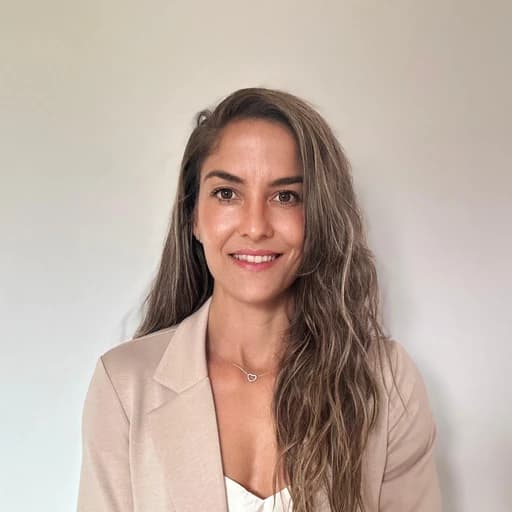
Written and reviewed by
Yanira Soto Cabrera
Licensed general health psychologist (Psicóloga General Sanitaria) · Registration No. T-03737 (COP Santa Cruz de Tenerife)
Co-founder of AtHomePsicología. Over 10 years of clinical experience with anxiety, depression, relationship difficulties and self-esteem, working from cognitive behavioural therapy (CBT).
Meet our English-speaking psychologists